
Thursday, September 10, 2015
Käthe Kollwitz Death Seizes a Woman (Tod packt eine Frau) from the series Death (Tod) (1934)


This picture that Kathe created was for Karl Liebknechts family. They asked her to create a piece of art work in memory of their son who was a socialist leader that was brutally murdered by right-wing paramilitary forces in Berlin. This is a picture of his working class followers mourning his passing.
This neat artwork was created by woodcutting as well as using black and white ink.
"Solidarity" Kathe Kollwitz
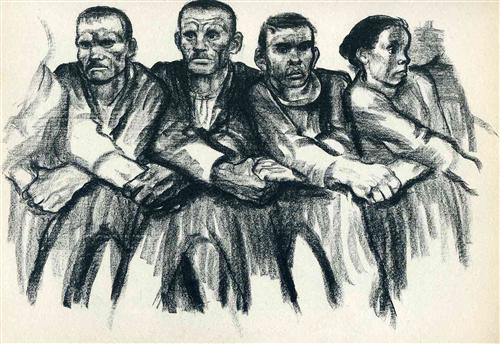
"Solidarity"- Kathe Kollwitz 1932
This drawing was created by Kollwitz to express the unity and solidarity with the soviet people who were threatened by the Nazi party. I chose this drawing because of my feeling towards people from different backgrounds coming together to stand against a mutual oppressor.
Wednesday, September 9, 2015
Kathe Kollwitz - Death, Woman, and Child (Tod, Frau und Kind)

This drawing by Kathe Kollwitz was created in 1910. Death appears to be a common theme throughout Kollwitz's works, and this drawing is no exception. I admire the fact that Kollwitz appears to be personifying death as a moving shadow. Her use of shading makes it seem as though death is darkly and quickly enveloping the mother and her child as they sleep, which gives the drawing an overall ominous vibe. I also appreciate how Kollwitz was able to depict a solemn yet peaceful expression on both the mother's face and her child's face as they appear to be overtaken by death.
Kathe Kollwitz: Vienna Is Dying! Save Its Children!

This work of art by Kathe Kollwitz was created during the 1920s crisis are pleas to others to help the suffering men, women, and children that are dealing with post-World War I food shortages, unemployment, and inflation. In the poster she uses the skeleton to represent death and starvation in Austria lashing at the children. I chose this poster because it represents the torture and death these people had to go through during the space between the two world wars. The skeleton is meant to shock you into seeing what these people were going through at the time.
Kathe Kollwitz

I chose this piece of work by Kollwitz because it shows the audience exactly how the depicted person felt. This is a woodcut from a portfolio of seven other woodcuts that all show a story of the aftermath from World War I. This piece shows the extreme sadness of a widow and you can see from her detail how incredibly heavy the grief was during this time.
Kathe Kollwitz

I found this drawing by Kathe Kollwitz interesting for many reasons. While the work may come off as "dark" or "dramatic", I like the way she used different techniques to complete it. Her use of shading shows depth and also enhances features on the individual. Also, I liked her use of lines; she used lines for detail, features, contouring and shading. It is for these reasons I like this piece by Kathe Kollwitz.
Subscribe to:
Posts (Atom)